


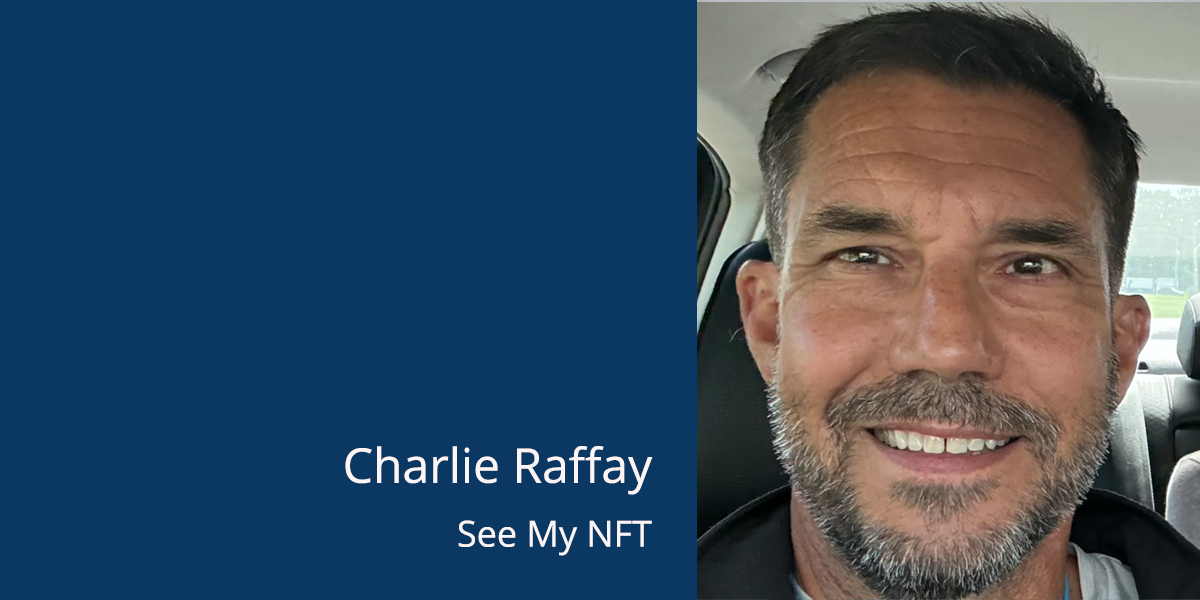
When COVID hit and the company Charlie Raffay was working with began laying off its development team in the Philippines, Raffay couldn’t watch it happen. The developers had left good jobs on a promise. Now the promise was being broken.
He quit. He called his wife and told her they were going into their retirement savings to hire those developers back.
“They quit very well-paying jobs for them and now you’re leaving them in the lurch,” he says. “I can’t deal with that. Your men have to eat first.”
He didn’t have a product or a business plan. What he had was a data model he’d been refining since the early 1990s, and now he had the people to help him build it. Some of those developers have been with him for more than eleven years now. Nobody on the current team has been there less than five.
Raffay graduated from West Point in 1989 with a degree in engineering management. A year and a half later, he was commanding a tank platoon in Desert Storm, part of the 2nd Battalion, 70th Armor Regiment, 1st Armored Division. His unit was on the left hook, the flanking maneuver that swept deep into the Iraqi desert while the cameras stayed at the port.
“Nobody knows our story,” he says. “We were way out in the desert. It was a secret. Nobody was embedded with us. We fought the largest tank battles since World War II. Very, very intense combat.”
A book about the campaign, Bandit by Mark T. Gerges, was published in 2026. Gerges commanded Bravo Company; Raffay served in Charlie Company, right alongside.
After the Army, Raffay went to work as an engineer at American Greetings. He bought a $70,000 scheduling package for one of their printing plants, then called the IT department to get it installed. They asked if he had a budget number. He didn’t know what that was. They told him they might get around to it in two years.
“I just got out of the army,” he says. “I don’t know what the heck you’re talking about.”
So he found a colleague who could write SQL, taught himself Microsoft Access, and built the system himself. In the process, he designed a data model that he would keep developing for the next three decades.
That model eventually became See My NFT, a platform built on what Raffay calls a multi-tenant temporal hypergraph. He is the first to admit that the name alone can lose a room. The system tracks entities and relationships over time, logging every ownership change across as many clients as needed, with a full audit trail.
“I’d probably be like a VC’s worst nightmare,” he says. “You say, hey, give me the thirty-second pitch. Thirty hours later, we’ll still be talking about it.”
The platform combines more than a dozen functions that most businesses stitch together from separate services: social media, accounting, ticketing, streaming, e-commerce, direct messaging, and an app distribution system that bypasses Apple and Google entirely. See My NFT holds a patent for distributing apps as NFTs, which means a ticket, a membership, or a piece of music can be delivered as a unique token that also functions as a standalone app, saved directly to the user’s phone without an app store download.
One brand running on the platform is Ticket Appster. A customer buys a concert ticket, gets an email with a link, saves it to their home screen, and now has both the ticket and an event app without downloading anything.
Raffay’s target clients range from musicians looking to build direct relationships with fans to brands that are tired of cobbling together twenty platforms that don’t talk to each other. He is drawn to the thousand true fans theory, the idea that an artist who can sell $100 worth of value to a thousand loyal supporters can make a sustainable living. He has built the infrastructure to make that possible without the middlemen taking thirty percent.
But the road between the idea and a working product nearly ended more than once.
Before See My NFT, Raffay had been in real estate. The 2008 financial crisis destroyed that business completely. He lost his house, his cars, and his health insurance.
Then he started seeing blood when he urinated.
“I looked up online and said, well, it could be kidney stones,” he says. “Or it could be bladder cancer. I was like, no, I’m early forties. I can’t have bladder cancer.”
He didn’t know he qualified for VA healthcare as a combat veteran. Nobody had told him. For years, the bleeding came and went. He convinced himself it was a runner’s condition.
It wasn’t. In 2017, after finally getting into the VA system, Raffay was diagnosed with bladder cancer. He called his commanding officer from Desert Storm, who had fought stage four fully metastasized colon cancer in his early thirties and survived.
“Lieutenant, you need to buck up,” his CO told him. “I had stage four fully metastasized cancer, and I’m here, and you’re gonna still be here.”
Most of the officers in Raffay’s Desert Storm unit ended up with cancer, likely from wartime exposures. He also deals with a traumatic brain injury from a tank blast, swallowing problems, and bowel issues connected to his service.
The cancer progressed from superficial to muscle-invasive. Surgeons removed his bladder, his prostate, and everything around them. For nearly four years, he had no bladder control.
“My wife was a trooper,” he says. “Getting up in the middle of the night, flushing out my bladder.”
He was building a company through all of it.
Raffay lives half the year in Jensen Beach, Florida, and the other half in Madrid, where his wife is from. His family is what he credits with carrying him through.
“I’ve got a very good nuclear family, my kids very supportive, my wife’s very supportive,” he says. “That was a good basis.”
Today, See My NFT is in production and bringing on a sales team. The platform recently added agentic AI on top of the hypergraph, allowing automated processes to operate within the data structure’s built-in permission system.
When asked what keeps him going, Raffay doesn’t reach for anything complicated.
“Whether it’s a startup or whether it’s recovering from bladder cancer, you just gotta get out of bed and you gotta take those first steps,” he says. “A couple steps today, a couple steps tomorrow, a couple steps the day after. If you do that consistently, you can travel a long way.”
The foundation is the same one he learned as a young lieutenant crossing the desert in a tank. Your men eat first. And you keep moving.
Charlie Raffay is the Founder of See My NFT, a platform built on a patented multi-tenant temporal hypergraph that combines e-commerce, streaming, ticketing, social media, and app distribution into a single system. A West Point graduate and Bronze Star recipient, Raffay served as a tank platoon leader in Desert Storm with the 2nd Battalion, 70th Armor Regiment, 1st Armored Division. He is based in Jensen Beach, Florida, and Madrid, Spain.