


We’re Gonna Go Until Someone Tells Us This Is an Absolutely Stupid Idea
Michael Bynum · Co-Founder & CEO, VigilanceIQ
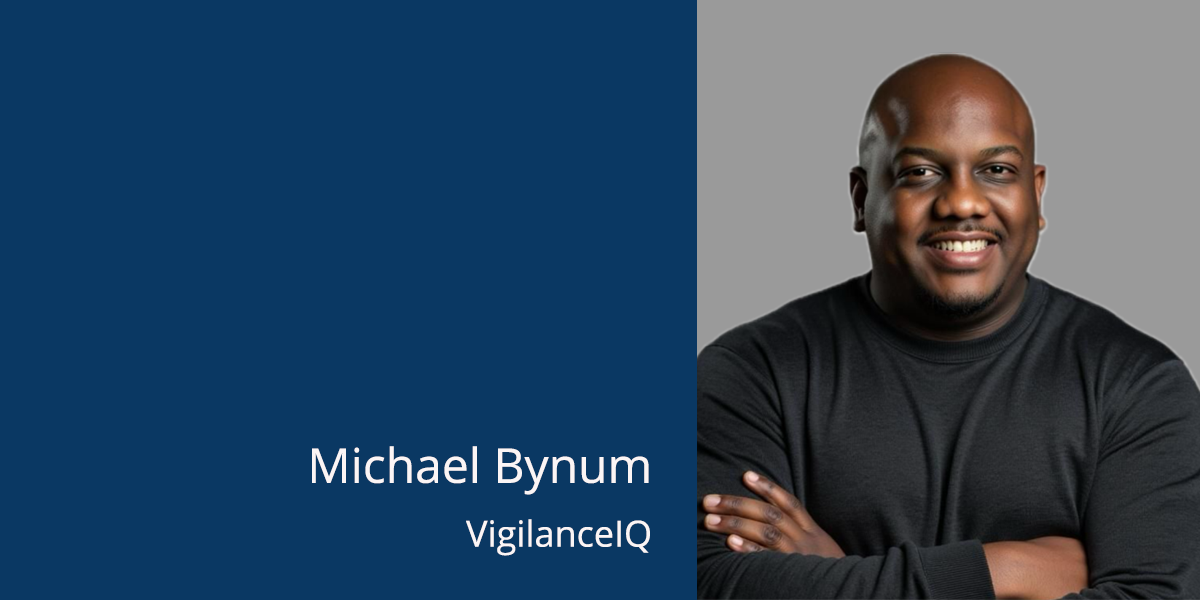
Halfway through his MBA at Washington University in St. Louis, Mike Bynum walked into the dean’s office and told him he wasn’t sure he belonged.
There were people in his cohort running pivot tables and building financial models. Bynum had spent fifteen years in the Army making decisions that could put someone in jail or get someone killed. Spreadsheets were not the problem. The problem was that he couldn’t figure out why he was there.
Bynum enlisted in 2002 as a Korean linguist and interrogator. He spent his entire enlisted career at Fort Bragg, rotating between USASOC and JSOC. In 2007 he was direct-selected for Officer Candidate School and commissioned as an infantry officer. Platoon leader and executive officer time at Fort Lewis. Company command back at Bragg. He separated in 2017.
“Starting a company from scratch is absolutely crazy,” he says. “But in the military, we were doing stuff that the average person just can’t do, or won’t do. There’s just no task that can’t be completed. That mentality is at the base of all this.”
Bynum had enrolled at WashU on a Yellow Ribbon scholarship. The school runs a cohort of twenty veterans through the MBA program each year, tuition covered. He needed those two years to take a knee and translate everything he’d learned into civilian terms. But he wasn’t prepared for how out of place he’d feel.
“There’s people doing pivot tables. There’s all these geniuses around me,” he says. “I was like, I don’t know if this is for me.”
The dean pushed back. He told Bynum to ask his classmates how many people they’d ever been in charge of. Then he told him something that reframed the whole experience: in the business world, most people struggle with making decisions, and even more struggle with making courageous ones.
“That’s a Tuesday for us in the military,” Bynum says. “You might be docking someone’s pay, you might be putting someone in jail, you never know. But you find that folks struggle with hard discussions like that outside of the military.”
The advice went further. Bynum had been staying up until three in the morning trying to perfect every assignment. He had to repeat his core finance class. He was getting frustrated. Then someone at WashU told him something he’s never forgotten: We’re not trying to build CFOs here. We’re not trying to build CMOs and data scientists. You just need to learn enough to call bullshit, and you need to know enough to keep yourself out of jail.
“He was like, we’re not looking for the right answer. We’re just looking for an answer,” Bynum says. “So that shifted my whole mindset. It was like, hey, the CEO who needs to ensure he stays out of jail. Similar to the commander. It was a language I could understand.”
After the MBA, Bynum moved into venture capital and then into the defense technology space. At FedTech, a venture-building firm that partners with government agencies, he grew a team from two to twenty-five and ran the Defense Innovation Accelerator, a program that paired aspiring entrepreneurs with breakthrough technologies coming out of DoD research labs to spin up startups.
That work put him directly in the path of the idea that would become VigilanceIQ.
Someone reached out to Bynum thinking he was still running the tech transfer programs. There was a technology they wanted him to look at. When he saw it, his background in special operations clicked into place. Fatigue had been a planning factor in every mission he’d ever been part of. He knew what it cost.
“I was like, hey, I want to raise my hand and work with this,” he says. “I tapped the shoulder of my co-founder, who’s a former SpaceX and Boeing software engineer, just to make sure I wasn’t crazy about some ideas I had. And we decided to stand up VigilanceIQ.”
The company is solving for fatigue in high-risk operations. Its AI platform combines Army sleep science, licensed from the U.S. Army, with an individual’s work and sleep patterns to predict whether someone will be dangerously fatigued twelve to twenty-four hours before their shift or mission starts. The prediction improves with each cycle, learning from each person’s data.
The beachhead market is enterprise trucking. Medium to large logistics operators, companies running fifty to seven hundred trucks, where a fatigued driver is not a productivity problem but a mortal one.
“My kind of mantra on this entrepreneurship journey is like, we’re gonna go until someone tells us this is an absolutely stupid idea, no one would pay for it,” Bynum says. “But so far it’s been yes, yes, yes. That’s absolutely needed.”
Bynum joined the Missouri Truckers Association and got himself onto the safety council. At his first meeting, held at a weigh station, they let him pitch VigilanceIQ. The head of the safety council invited him to their site. They run about seven hundred trucks.
“We’re gonna see if we can’t start a pilot,” he says.
The company recently received an Arch Grant, one of the major funding organizations in St. Louis, along with a fifty-thousand-dollar investment from a family that owns a local newspaper. That capital is buying runway for the pilot and the fundraise that follows.
The longer-term vision extends to aviation and defense. Air traffic controllers, warfighters, pilots. If VigilanceIQ can prove the model works in trucking, Bynum believes the other industries will follow.
Ask Bynum about VigilanceIQ and he’ll give you the elevator pitch. Ask him about building a team and he won’t stop talking.
VigilanceIQ’s first hire came through LaunchCode, a St. Louis workforce program that retrains people as software engineers. Bynum took the new hire to lunch. He introduced himself. He asked about the person’s life, their family, what they cared about.
“They were like, wow, this is the first time someone’s actually sat down with me and talked to me and asked me about my life,” he says. “I run into that quite a bit with every role I’ve been in. Folks don’t experience a leader caring about them or their family.”
He draws a direct line from the habits that felt routine in the military to what he considers a competitive advantage in the civilian world. Someone’s always watching you. Don’t eat before the troops. The small things that felt tiresome in uniform turn out to be rare in the commercial world.
“All of those lessons from the military, the ROI out here in the civilian space is tenfold,” he says.
When he talks to other veteran founders, he keeps coming back to something WashU almost had to beat into him. Talk about your military experience. Stop treating it like it’s unremarkable just because it feels normal to you.
“There’s the severe, extreme humbleness that we have, just kind of having that selfless service,” he says. “I think sometimes we stick to that at a fault. Folks who have actually been down that road can run laps around your average human being.”
He tells a story about riding in an Uber recently. The driver was a veteran thinking about starting a business. Bynum’s advice was short: don’t think about it anymore. Just do it.
“What I love about this space is it’s a fail-forward space,” he says. “Even if your business crashes and burns, you are gonna be so much better for the second one or the third one or the fourth one. I’m just hoping folks can take that courage that we needed to jump out of planes and go start a business, man. You’ll do well one way or the other.”
Michael Bynum is the Co-Founder and CEO of VigilanceIQ, a predictive fatigue intelligence platform that combines Army sleep science with AI to identify dangerously fatigued workers before their shift begins. A U.S. Army veteran, Bynum served fifteen years as a Korean linguist, interrogator, and infantry officer with assignments at USASOC, JSOC, Fort Lewis, and Fort Bragg. He holds an MBA from Washington University in St. Louis and previously led the Defense Innovation Accelerator at FedTech, where he paired DoD research technologies with entrepreneurs to launch dual-use startups. VigilanceIQ is based in St. Louis, Missouri.