



People Lie, but the Data Never Does
Dr. Michael Pendleton · Founder & CEO, The AI Cowboys
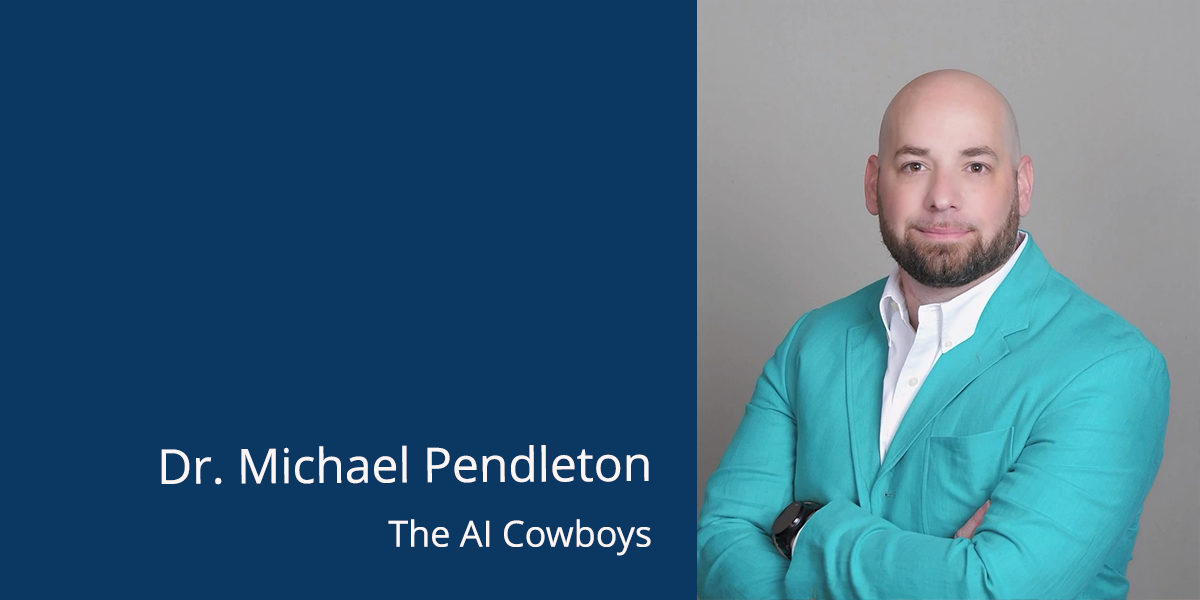
Mike Pendleton woke up one morning shortly after retiring from the Air Force and started scrolling through his phone. Twenty-plus years of service. Eight combat deployments. And now he was lying in bed with no mission on the calendar.
"Man, what am I gonna do with my life?" he remembers thinking. "Who is Mike? Not who has Mike been told he was for the last 20-plus years. Who is Mike?"
He found the answer on YouTube.
Pendleton started watching videos on data science and coding. He taught himself Python. He calls it the University of YouTube, and he says it with the grin of someone who got exactly what he needed from a free education. One subject kept pulling him deeper into the next until what started as curiosity turned into a company.
"Unfortunately, people lie, but the data never does," he says. "If you just listen to the data and let it tell the story objectively, authentically, it'll tell you everything you need to know."
He built The AI Cowboys on it.
Founded in 2024 and based in San Antonio, The AI Cowboys is a Service-Disabled Veteran-Owned AI lab doing data science and machine learning engineering for government agencies and enterprise clients. Pendleton, who holds an applied doctorate in AI and machine learning engineering from George Washington University, built the company on the premise that AI is only a black box to people who don't do AI.
"AI is a black box to people who don't do AI," Pendleton says. "I'm an AI engineer, man, and a data scientist by trade. I know exactly what it's doing. I know how to control it." He compares it to car engines. He can't diagnose a misfire, so the engine is a black box to him. A mechanic knows every rattle. "I mean, hell, my kitchen's a black box, man. I don't know how to cook."
His client list suggests that argument is landing. The AI Cowboys has done work for the multiple federal agencies. They recently won a Phase Two contract, building data science and machine learning models focused on Lyme disease research. On the private sector side, they have partnered with the who’s who of tech, from AMD to Hyperscaler’s and Neocloud providers, among many others. The company is currently ranked sixth among AI startups in Texas and holds a residence at the UT San Antonio National Security Collaboration Center.
When people ask Pendleton what The AI Cowboys does, his answer is short.
"All of it," he says. "People used to say, 'No, you can't.' And I'm like, okay. I got the bank account and the receipts to prove it."
The company and the doctorate came later. Pendleton was an operator in the Air Force first, and for a long time. He served more than twenty years with four deployments to Iraq and four to Afghanistan. He is originally from Louisiana and now calls San Antonio home. He doesn't talk about his service with distance. He connects it directly to how he runs his business.
"You gotta really maintain that discipline to be able to press forward when you get into a complex situation," he says. "I think data science is no different. You have to have that discipline when you have all this data and you're trying to process it for a complex situation to provide a solution. You have to stick with it."
One story he tells captures the scale of where the company is operating. A year and a half ago, Walmart's corporate AI team flew Pendleton to Bentonville to meet. The person across the table, the executive under Walmart's CTO who oversees AI for the company, told Pendleton something he has carried since.
"He said, 'Mike, you don't understand how much of a commodity you are. Don't undersell yourself,'" Pendleton recalls. "'I've sat across from Google, NVIDIA, Microsoft. They're like a huge ship. They can't turn on a dime. We would have to pay them to scale down, and it's easier and more cost-effective for us to just pay you to scale up.'"
Pendleton already suspected the value of being small and fast in a market dominated by trillion-dollar companies. The Walmart conversation confirmed it. The big players cannot move at the speed their customers need. Someone like Pendleton, who can walk into a meeting in shorts and a T-shirt one day and put on a suit to sit with the White House's director of cybersecurity and the governor of Texas the next, operates on a different frequency entirely.
The company has fielded three acquisition offers. The most recent was for millions of dollars. Pendleton told his lawyer to say no.
His reasoning wasn't a hunch. New contracts were coming in that changed the math. If the business was already worth nine million before that revenue hit, the number could only go up. He looked at what was on the books, looked at what was coming, and decided the offer was too early.
"It's humbling," he says. "This started out as a funny idea while I was waiting to pick up my daughter from cheerleading practice."
Scaling is the current challenge, and Pendleton is direct about the fact that he doesn't have it figured out.
"Everybody wants to be seen as the expert, but I think challenges and failures should be talked about, too," he says. "I don't have a playbook on scaling my business. I'm just guessing."
The talent he needs exists, but the market for AI and machine learning engineers at his level is thin. He knows the people he wants. Some of them have PhDs from Harvard and undergrad degrees from Princeton. Most of them are already well-employed somewhere else. The revenue is there. The contracts are there. What he hasn't solved yet is how to build the team fast enough to keep up with the work coming in.
He carries the same candor into how he talks about the veteran founder community in San Antonio. Pendleton credits the Texas Veterans Commission and the SBA with early help, but he is careful about the broader ecosystem. He watches other veteran founders struggle and wants to help, and he also recognizes that twenty years of service gives a different perspective than four.
"Humility is a key leader trait," he says. "I had a lot of different experiences than other veterans. They had a lot of different experiences than me. Not better or worse, just different."
He recalls advice from a longtime mentor and successful technology entrepreneur who shared a difficult lesson: many of the most successful businesses based in San Antonio often find their largest opportunities outside the local market. It was not necessarily advice he wanted to hear at the time, but he recognized the value in the perspective. The data supported the idea that growth sometimes requires looking beyond geographic boundaries. Their clients are federal agencies and multinational corporations. The C-suite executives who fly in on private jets to visit the company's lab come from out of state.
He admits the advice was difficult to accept because it challenged some of his assumptions about building a company. “I’m frustrated because the perspective was right,” he says. “It’s not that I wanted the advice to be wrong. It’s that sometimes the hardest lessons are the ones that force you to rethink your approach.” He says he has shared that frustration with his mentor, especially as he has recently reflected on the realities of growing a technology company.
What Pendleton wants most from the veteran community is the same thing he is trying to give back to it. He wants to be an example. He talks about standing on the shoulders of giants and leading the way for those coming behind him. He wants to bring five or ten veterans along and show them there are opportunities if they apply themselves and use the resources available.
"Let me just be very clear," he says. "I've been told no more times than I've been told yes, and I've failed way more times than I've succeeded. This right here is real life. This isn't social media where everybody's doing great if you just let them tell it."
When asked for advice to other founders, Pendleton reaches for a country song. "The Ride," by David Allan Coe. In the song, a hitchhiker gets picked up by a stranger driving an antique Cadillac on the road to Nashville. The stranger turns out to be Hank Williams. The message is that if you're bound for the big time, it's a long, hard ride.
"That's the advice I give to people," Pendleton says. "You gotta really be committed to being an entrepreneur. It's a long, hard ride. You have to be committed."
A few years ago, he was scrolling through his phone in bed, wondering who he was without a uniform. Now he runs an AI lab with federal agencies and Fortune 500 companies calling his number. He has turned down millions of dollars and says the ride is just getting started. But he doesn't pretend the view from the saddle is always good.
"There's great days, there's horrible days, and there's days where I've been like, I don't wanna do this anymore," he says. "This right here is real life."
Dr. Michael Pendleton is the Founder and CEO of The AI Cowboys, a Service-Disabled Veteran-Owned AI lab in San Antonio, Texas, specializing in AI, machine learning, data science, and cybersecurity for government and enterprise clients. A retired Air Force operator with more than 20 years of service and eight combat deployments to Iraq and Afghanistan, Pendleton holds an applied doctorate in AI and machine learning engineering from George Washington University. The AI Cowboys is an NVIDIA Deep Learning Institute and IBM SkillsBuild partner, resident at the UT San Antonio National Security Collaboration Center, and currently ranked sixth among AI startups in Texas.