


I’d Rather Be Disliked for Who I Really Am Than Loved for Who I’m Not
Odie Gray • Army Veteran & Founder, Dominus Gray / Diversity Cyber Council
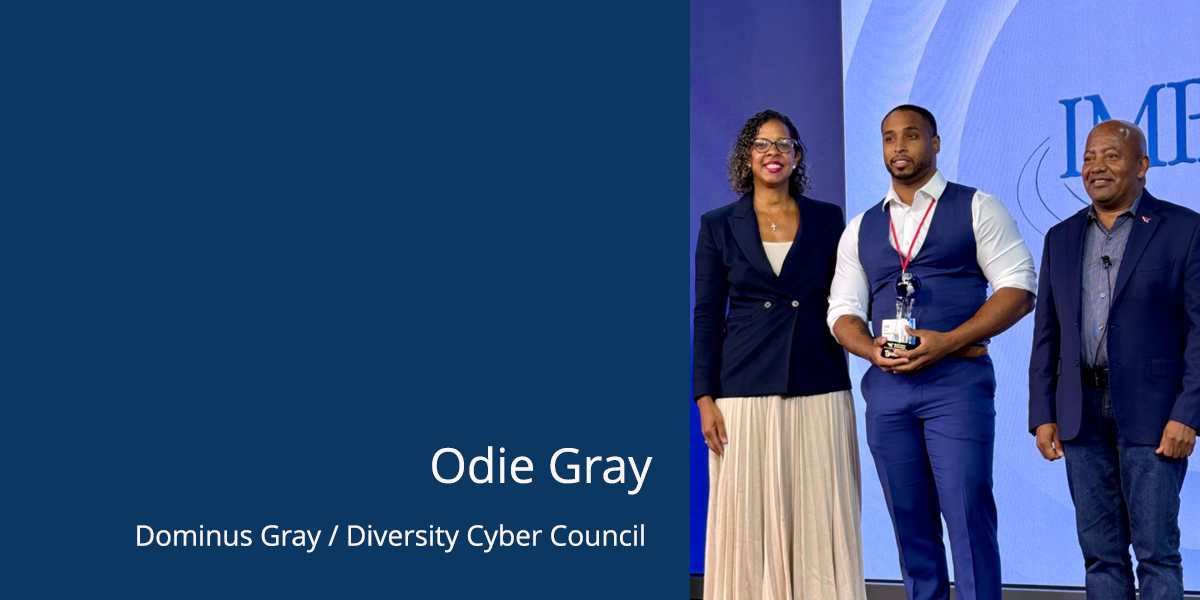
Odie Gray was kicked out of high school. The way he tells it, the options that followed were simple: join the military, or face a future with almost no path forward.
He chose the military. He was eighteen years old.
“It was a matter of stay in this situation with little to no options, or take a chance on yourself and serve the country,” he says. “So, you know what I chose.”
Gray enlisted in the Army and started in flight operations, half-expecting he’d end up in a cockpit. That didn’t happen. By his second or third year, he’d reclassed to 25 Bravo, information security, and shipped to Fort Gordon in Augusta, Georgia for training. He didn’t know it yet, but that reclassification would become the foundation for everything he’s built since.
“I feel like so much was fated about me joining,” he says. “Because that was the foundation for sure.”
Before the Army, Gray had what he calls a rough childhood. He doesn’t go into detail, but he’s clear about the cost of never pausing to process what he’d been through. He went from a difficult early life straight into military service without the tools or the time to make sense of any of it.
“I just kind of stormed through all of this,” he says. “Never took a moment to digest, to process what I want to be and who I am from those experiences.”
That reckoning came later. Years after separating from the Army in 2013, Gray sat down and did the work of sorting through what had shaped him, separating genuine influence from what he calls miseducation or indoctrination, and deciding what he actually wanted to carry forward.
“It was really important for me to say, what was the influence? What was miseducation, what was indoctrination, and what is it that I would like to be in the state of being moving forward?”
Today, Gray runs two organizations out of Texas. Dominus Gray is a cybersecurity consulting firm focused on compliance readiness. The company performs assessments, determines where a client’s cybersecurity maturity stands, and builds a roadmap to strengthen it. The work centers on frameworks and certifications that are becoming increasingly mandatory: CMMC, FedRAMP, NIST, ISO.
“Things are about to get a lot more interesting,” Gray says, “because we’re gonna see more enforcement at the federal and state level.”
He points to the Texas Cybersecurity Act, enacted around 2020 or 2021 with a five-to-seven-year enforcement buffer. That buffer is closing. Businesses that haven’t prepared are about to find out the hard way that compliance isn’t optional.
His second organization, Diversity Cyber Council, is a 501(c)(3) nonprofit that teaches technology skills to people from underserved communities and underrepresented professional backgrounds. The goal is to get graduates into viable entry-level technology careers. The program goes beyond technical training to include financial literacy, leadership development, and career readiness.
Gray started the nonprofit as homage to his military service. What he missed most after leaving was the camaraderie.
“You have people from all different backgrounds, cultures, all that. Doesn’t matter. We all come together at the end of formation. We hang out, we have some beverages, we tell stories. It’s a different experience than being a civilian.”
Diversity Cyber Council is built on that same principle: we’re stronger together. Gray is aware that the language around diversity and inclusion has become politically charged, but he’s not interested in the debate. He’s interested in the results. He’s watched single mothers go through the program, learn new skills, and triple or quadruple their income.
“That’s what keeps me so motivated to continue,” he says.
He also sees the nonprofit as preparation for a shift that’s already underway. By 2030, he expects automation to eliminate a significant number of low-skill positions. Workers without technology skills will find themselves increasingly shut out. Diversity Cyber Council exists to close that gap before it widens further.
Gray’s philosophy on entrepreneurship is blunt. Being a founder is not a profession. It’s a lifestyle.
“Take all the sexy appeal away from what you think being an entrepreneur is,” he says. “Focus on solving a problem and committing to being a problem solver for your tenure as an entrepreneur.”
He’s equally direct about where founders waste their energy. Early in his own business, he spent time banging on doors that had already proven they wouldn’t open. He’s since adopted a simpler principle: go where you’re valued.
“There are some spaces that simply won’t acknowledge your value,” he says. “And it is a waste of your time, energy, and greatness to continue to remain stuck in those places thinking that they would one day. No. Just go somewhere else.”
“Rejection is redirection,” he says. He arrived at that after years of learning where to spend his effort and where to walk away.
One of Gray’s more unconventional positions is about how small businesses should grow. Rather than encouraging founders to wear ten hats and become generalists, he thinks the ecosystem should support mergers earlier. Five cybersecurity consulting firms his size, all operating independently, could merge and receive grant funding to grow together. He believes that model would produce more sustainable small business growth than the standard advice of doing everything yourself.
“As a founder, as a CEO, I don’t think you’re meant to have to wear ten different hats and be an expert at ten different things,” he says. “My goal is to recruit people who are highly passionate about what they do and then assign them into my business to deliver on that need.”
The lesson he carries most visibly from the military is lead by example.
“It’s really convenient to be a star leader when all eyes are on you,” he says. “But when you’re doing the right thing and nobody’s looking, when you’re doing the right thing when it doesn’t necessarily benefit you in that particular situation, I think there’s something really courageous about that.”
Outside of work, Gray writes. He was first published at age eleven and still writes in his spare time. He sees it as a way to sit with himself.
“You can be highly analytical. You can be sci-fi. You can be creative. Whatever your mind can think of, you can put it to paper,” he says. “You don’t have to necessarily be good at it. Just do something that you like.”
He’s also a certified PADI open water scuba diver, a regular at the gym, and a serious traveler. He recently returned from Peru, where he hiked to Machu Picchu and discovered the altitude was more humbling than he’d expected. He’s been to the Philippines. He credits the military with giving him the impulse.
“Traveling is the truest form of education,” he says. “And I gotta give credit to the military for exposing me to that.”
Gray starts and ends his days with meditation. Fifteen minutes in the morning, fifteen minutes before bed. Gratitude is central to the practice. He spent too many years, he says, focused on what was missing instead of what was there. He describes it with an image: someone receiving a birthday cake with one slice gone and spending the whole day fixated on the gap instead of the three-quarters that remain.
“Now I’m very conscious and intentional about saying, hey, even if a piece is missing from my cake, I still have a pretty big cake.”
“I’d rather be disliked for who I really am,” he says, “than loved for who I’m not. Because I’ll never be able to remove that mask.”
Odie Gray is an Army veteran and the founder of Dominus Gray, a cybersecurity consulting firm specializing in compliance readiness services including CMMC and FedRAMP certification. He is also the founder and president of Diversity Cyber Council, a 501(c)(3) nonprofit that provides technology education, financial literacy, and career readiness training to underserved communities. Gray served in the Army in information security roles before separating in 2013 and is based in Texas.