


Cash Flow Is Not a Theory
Douglas Clark · Co-Founder & CEO, aiidea
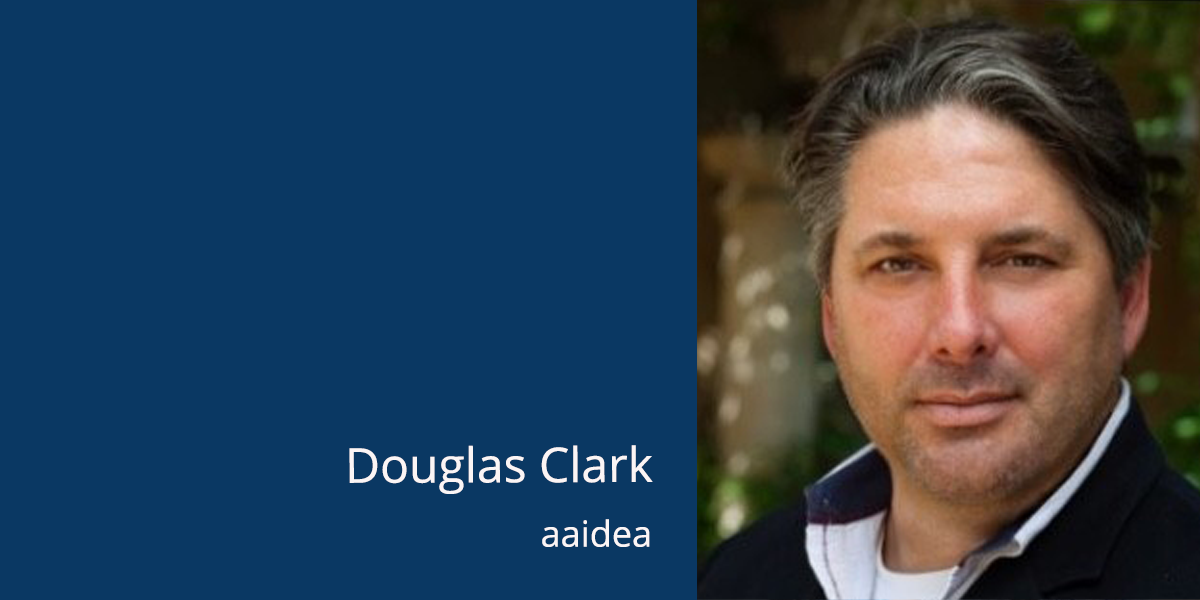
When Douglas Clark was a kid, he and his brother used to play a game with the dictionary. One of them would call out a page number, a column, and an entry. If it was an easy word, you had to give the definition. If it was a hard one, they gave you the definition and you had to figure out the word.
“I loved words,” Clark says. He still does. The rest of his career has been proving it.
Clark grew up out West and joined the Air Force straight out of high school. He served ten years. His first major assignment landed him at the National Security Agency. He’d been offered five jobs, and one required a security clearance. That was the one he picked.
At NSA, he took a six-month cryptanalysis course. Cracking codes all day, progressing through increasingly complex cipher systems until the class reached what humans can still break without a computer: syllabary squares. The final exam was a week-long exercise. Students had to crack a real-world cipher, reconstruct the network behind it, and explain what had happened.
“When you do that, you learn a lot about the patterns of language, patterns of grammar,” Clark says.
The code-cracking worked because of a principle called Zipf’s law, which governs the frequency distribution of letters, words, and structures in any language. It’s why Wheel of Fortune contestants pick R, S, T, L, N, and E. Those letters appear more often than any others, and they follow a mathematical curve that holds across every natural language ever studied.
Clark filed that away.
After the cryptanalysis course, he was assigned to an operations center that had been formed in the aftermath of the Iran hostage rescue attempt. His unit provided NSA-level intelligence to real-world operations around the globe. He volunteered to go to Beirut. He spent a year in Korea, where he worked with the U-2 program. He did three years in Germany.
“I just had a great time,” he says. “Flew all over the world, got to see places that Americans don’t always get to see.”
From the Air Force, Clark moved to the National Reconnaissance Office, where he spent five years working with satellites. The skill he picked up there was telemetry: the science of sampling measurements from a distance to reconstruct the health of a system you can’t physically reach.
Clark filed that alongside the graph theory, the cryptanalysis, and the patterns of language. He didn’t have a plan for any of it yet.
After leaving government, he landed in the Bay Area. A short startup stint served as his bridge to the civilian world. He met his wife during that period, and together they co-founded Métier, a SaaS company that built enterprise work management software. They ran it for 17 years out of Washington, DC.
Métier made the Inc. 500/5000 list five times and landed on the Gartner Magic Quadrant. The company won contracts with the Department of Defense and the FBI, where Clark met Director Mueller. It was a real business by any measure. But the whole time, he kept circling the same question. Could you look at the data inside an organization’s work, its project records and communications, and tell the story of what was actually happening?
He tried a few approaches at Métier. The tools weren’t there yet.
They sold the company in 2016.
“I was the world’s greatest bum for two years,” Clark says. “I challenge anyone to have done better than me during that period.”
Then the tools caught up. Tensors arrived. Early machine learning capabilities matured. Clark, who had spent decades studying the patterns of language, recognized what was happening.
“It was kind of dropped in my lap,” he says. “Here, you’ve always wanted this hammer. Here’s the hammer.”
He had one thing to prove before he could build anything. Zipf’s law governs letters. It governs words. Clark needed to show that sentences follow the same distribution. If they did, the same mathematical principles that let him crack codes at NSA could be applied to understanding how humans communicate at the scale of an entire organization.
So he ingested all 161 million sentences of Wikipedia. And he proved it.
From that proof, Clark and his team built the aiidea Graph, a hybrid of large language models and knowledge graphs that represents how ideas are communicated. The company name borrows from the Japanese. The word for “idea” is spelled A-I-D-E-A and pronounced the same as in English. Clark added an extra I and kept the pronunciation.
What aiidea builds is semantic infrastructure for enterprises that need to trust the provenance of the data behind their decisions. The product captures how humans actually communicate, then maps that communication into a structure that can be analyzed for transparency and governance.
“Where does that come from? My military background,” Clark says. “My NSA background. You had to know the provenance of the data you were reporting on.”
The company launched in early summer 2026 after 18 months in stealth development. Its initial market is data and AI consultancies that need new products for their clients, along with government agencies and Fortune 100 labs willing to stress-test the system. Clark’s team ran an early pilot with BAE Systems at NRO.
Clark is direct about where things stand. They’re in alpha and beta, focused on their go-to-market strategy. In a space moving as fast as AI, he knows the window is finite.
“I don’t see us lasting very long if we execute well,” he says, meaning the product is positioned to be acquired or scaled quickly. “And also because of the cost, we won’t stay around very long if we don’t execute.”
When he talks about what the military gave him, Clark doesn’t talk about discipline or toughness. He talks about collective intelligence.
“The other person is smart, but we are smarter,” he says. His wife calls it a Doug-ism. “I just feel so much smarter, and I know we can do a better job when we get good, smart people with all eyes on the problem.”
The other lesson he carries is simpler. A leader’s job is to figure out what each person does well and keep putting them in positions to do it. “People call it empathetic,” he says. “Whatever it is for you, it’s figuring out a way to find out what your people can do.”
Clark has put that into practice beyond his own companies. He’s mentored veterans through SkillBridge, including one who landed at FedTech in DC and went on to build a company of his own. At Métier, he created a program called Protectors to Project Managers, which helped wounded warriors earn their PMI certifications.
His advice to founders starting out is blunt enough that he acknowledges it kills the mood.
“Cash flow is not a theory,” he says. “A lot of times we get so caught up in our idea and our passion. But you can’t solve a problem if you can’t put food on the table.”
Clark lives in St. Augustine, Florida, with his wife. They moved from Washington, DC, where they’d been for more than 20 years, to be closer to her mother. He keeps rescue dogs. He learned to fly later in life, a dream he’d carried since childhood.
“I was always the kid that gets the toy and then takes it apart,” he says. “I think that’s my passion, trying to understand things and then showing others what I learned about how it works.”
He’s been taking things apart since he was a boy with a dictionary. The dictionary led him to cryptanalysis at NSA. Satellite telemetry at NRO came next, then 17 years of enterprise software. All of it led to a proof that the patterns he’d spent his career studying could be captured in code. The tools took four decades to arrive. Clark was ready when they did.
Douglas Clark is the Co-Founder and CEO of aiidea, a semantic intelligence company building hybrid AI and knowledge graph infrastructure for the enterprise. An Air Force veteran, Clark served ten years including assignments at the National Security Agency, with deployments to Beirut, South Korea, and Germany. He previously co-founded Métier, a five-time Inc. 500/5000 enterprise work management company that he led for 17 years. He lives in St. Augustine, Florida.