



Why the Number You’re Using to Make Growth Decisions Is Probably Wrong
A guide to calculating your real Customer Acquisition Cost and using it to make smarter growth decisions for your business.

The Bottom Line
Most founders calculate Customer Acquisition Cost the easy way: marketing spend divided by new customers. That number is almost always wrong, and it’s usually wrong by a factor of two or three. If you’re making growth decisions based on an incomplete CAC, you’re scaling blind. This article shows you how to calculate the real number and what to do once you see it.
What Happens When Founders Get Their CAC Wrong?
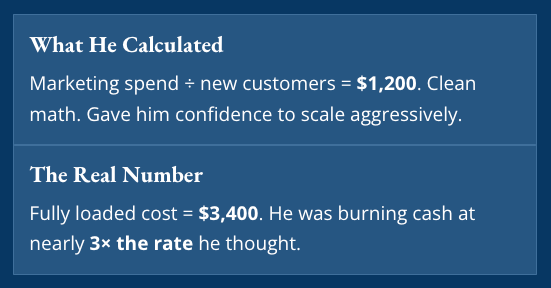
A B2B founder told me his Customer Acquisition Cost was $1,200. He’d done the math himself. Marketing spend divided by new customers. Clean division. Nice round number. It gave him the confidence to scale his sales and marketing spend aggressively.
The real number was $3,400.
He wasn’t building a growth engine. He was burning cash at nearly three times the rate he thought, and every “growth” decision he made was accelerating the problem.
At $1,200, his growth plan made sense. He could afford to scale spend aggressively and open new channels.
At $3,400, the math broke. He needed to be more selective about which customers to pursue and rethink his entire go-to-market strategy. More spend at a $3,400 CAC just meant bigger losses, faster.
Why Does the Simple CAC Calculation Fail?
Most founders include ad spend, maybe content or SEO costs, and divide by new customers that month. Done.
Here’s what they leave out:
Sales team time. Not just commissions, but fully loaded compensation for every hour salespeople spend on calls, demos, follow-ups, and proposals. Tools and software across the sales stack. Demo and trial costs, including the infrastructure to support free trials or pilot programs. Overhead allocation for the sales and marketing function. And the one nobody wants to count: the cost of deals that didn’t close but still consumed weeks of time and energy.
You can’t exclude costs just because they’re inconvenient. Every hour your sales team spends on a prospect who doesn’t convert is still a cost of acquisition. It just gets spread across the customers who did convert.
How Do You Calculate Real Customer Acquisition Cost?
The formula is simple. Unfortunately, most founders don’t take the time to pull the numbers.
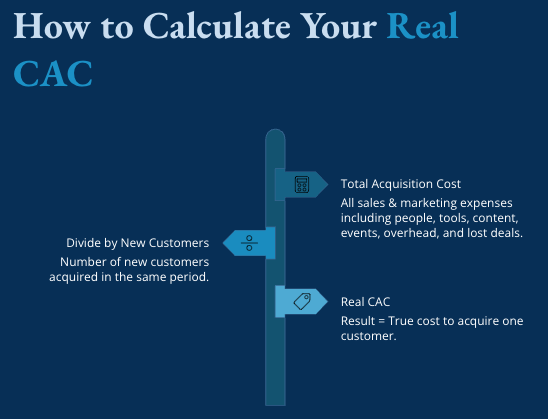
Take your total fully loaded sales and marketing costs for a period. Everything. People, tools, overhead, content, events. Divide by the number of new customers acquired in that same period.
That’s your real CAC. No shortcuts. No leaving out the uncomfortable line items.
Why Does CAC Need to Be Paired with LTV?
Knowing your CAC matters. But CAC alone tells you almost nothing.
A $3,400 acquisition cost is fine if that customer is worth $30,000 over their lifetime. It’s a disaster if they’re worth $4,000.
Customer Lifetime Value (LTV) is the other half of the equation. Take your average revenue per customer per year, multiply by your average customer lifespan, subtract the cost to serve them. That’s your real LTV.
The general rule: your LTV should be at least 3x your CAC. If it’s less than that, you’re either acquiring customers too expensively or losing them too quickly. Either way, growth is burning cash instead of building value.
Most founders get optimistic here. They project retention based on hope, not data. Accurate measurement isn’t optional. It’s the difference between building on solid ground and building on a number you wish were true. Get it wrong and you’re putting yourself and your investors at a disadvantage.
Why Should You Break CAC Down by Channel?
Your overall CAC might look acceptable. But when you break it down by channel, the picture often changes.
Say your organic content generates customers at a reasonable cost. Your referral program brings them in even cheaper. But your paid advertising channel costs four or five times more per customer. Blend all three, and your average looks tolerable. But you’ve been increasing paid ad spend every quarter because it “feels like growth.”
CAC by channel tells you which channels to invest in and which ones to shut down. It tells you whether your growth is efficient or just expensive. The founders who scale well don’t just know their blended CAC. They know the number for every channel, and they make allocation decisions based on those numbers.
What Should You Track Besides CAC?
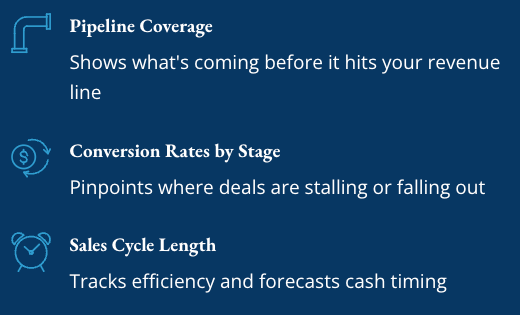
Revenue is a lagging indicator. It tells you what already happened, not what’s about to happen. Ready Founders™ track the indicators that predict revenue before it shows up: pipeline coverage, conversion rates by stage, and sales cycle length.
Pipeline tells you what’s coming. Revenue tells you what already happened. If you only watch revenue, you’re always reacting.
What Should You Do If Your Real CAC Is Too High?
 When founders see their real CAC for the first time, the reaction is usually some version of panic. Don’t let that push you into cutting everything. A bad number is still better than no number, because now you can fix it.
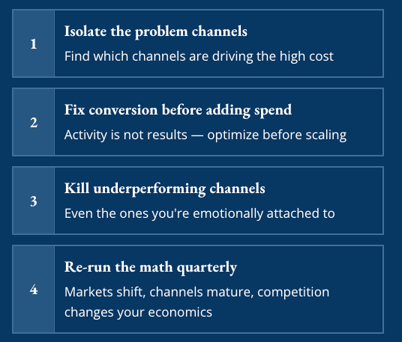
Start by isolating which channels are the problem. Fix conversion before you add spend. Kill the channels that don’t work, even the ones you’re emotionally attached to. Activity is not results.
And re-run the math quarterly. Your CAC isn’t a number you calculate once and forget. Markets shift. Channels mature. Competition changes your economics.
Your Challenge This Month
Calculate your real CAC. Include everything: sales team time, tools, overhead, deals that didn’t close. Be ruthlessly honest.
Then pair it with your LTV. Is the ratio 3:1 or better? If not, you know where to focus.
Finally, break your CAC down by channel. You’ll almost certainly find that one or two channels do the heavy lifting while others just add cost.
That analysis will tell you more about the health of your growth engine than a quarter’s worth of revenue reports.
Frequently Asked Questions
1. What is Customer Acquisition Cost (CAC)?
Customer Acquisition Cost is the total cost of acquiring a new customer. A real CAC calculation includes all fully loaded sales and marketing expenses: team compensation, tools, overhead, content, events, and the resources consumed by deals that didn’t close. The simple version (marketing spend divided by new customers) almost always understates the true cost.
2. How do you calculate CAC?
Divide your total fully loaded sales and marketing costs for a period by the number of new customers acquired in that same period. Include sales team compensation, software tools, demo and trial costs, overhead allocation, and resources spent on prospects who didn’t convert. Be honest about every line item.
3. What is a good CAC to LTV ratio?
A healthy LTV-to-CAC ratio is at least 3:1, meaning each customer should be worth at least three times what it costs to acquire them. If your ratio is lower than 3:1, you’re either spending too much to acquire customers or losing them too quickly. Both problems need to be addressed before scaling.
4. What is payback period and why does it matter?
Payback period is how long it takes to recover your Customer Acquisition Cost from a new customer’s revenue. In SaaS, twelve months is strong. Eighteen months is acceptable if you have the cash. Longer than that, and you need significant cash reserves to fund growth, because every new customer requires months or years before they become profitable.
5. How often should you recalculate CAC?
Recalculate your real CAC at minimum every quarter. Markets shift, channels mature, and competition changes your economics. Founders who track CAC consistently catch problems early. Founders who calculate it once and forget are often surprised when growth starts losing money.
6. What is the difference between blended CAC and CAC by channel?
Blended CAC is your overall average across all acquisition channels. CAC by channel shows you the cost for each individual channel, such as organic content, paid advertising, referrals, or events. Blended CAC can mask problems. One channel might generate customers cheaply while another burns cash, but the average looks acceptable. Breaking CAC down by channel reveals where to invest and where to cut.
Want the visual summary? Download the PDF version here.
The Ready Founder™ is part of One Degree Financial's commitment to helping founders gain the financial clarity and confidence they need to scale and exit successfully.
Ready to see where your business stands? Take the Ready Founder™ Assessment to find out where your financial leadership is strong and where the gaps are. Ready to build a growth strategy based on real numbers? Book a strategy session with our team.
Want the full version with real-world case studies and the complete playbook for fixing your CAC? Subscribe to The Ready Founder™ newsletter for the detailed breakdown, delivered monthly. Sign up here.
About the Author: Rod Loges is CEO of One Degree Financial and host of the MILCOM Founders podcast, where he helps veteran entrepreneurs build businesses with strong financial foundations.