


Why "We're Profitable" Might Be the Most Dangerous Thing a Founder Can Say
A guide to understanding profit by product, service, and customer segment for growth-stage founders

Most founders know their overall profit margin but can't answer a more important question: which customers, products, or services are actually making money? Without that visibility, you're making strategic decisions blind. This article explains how to analyze profitability by segment and why it matters for growth-stage businesses.
What Happens When You Can't See Your Real Margins
A founder came to us confident and relieved. "We're profitable!" Revenue was strong. The P&L looked good. The whole team was celebrating.
I asked one question: "Which type of customer is most profitable?"
Silence.
That silence costs founders millions every year. Because profit isn't a single number. It's the sum of every customer, every product, every service you offer. Some of these are making you money. Some are losing it. And if you can't tell the difference, you're making decisions blind.
When we dug into that founder's numbers, we found a customer segment where most of the customers were actually costing the company to service them.
On paper, everything looked fine. Revenue was growing. The overall margin seemed healthy. But underneath that headline number, some customers were generating strong profits while others were quietly draining cash with every invoice.
The profitable customers were subsidizing the unprofitable ones. And because this founder couldn't see the difference, they were investing equally in both. Marketing dollars went to attract more of the wrong customers. Their team spent disproportionate time on accounts that would never be worth the effort.
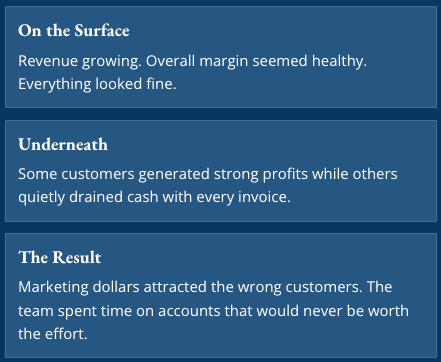
This is what I call the revenue illusion: you're making money overall, but you can't see where it's actually coming from or where it's leaking away.
What Are the Three Types of Profit Margin?
Most founders track one profit number: net income. But that single figure hides more than it reveals.
Ready FoundersTM (growth-stage business owners preparing for scale or exit) track three types of margin:
Gross Margin
Gross margin is the percentage of revenue remaining after subtracting direct costs.
- For product businesses: revenue minus cost of goods sold (COGS)
- For service businesses: revenue minus direct labor and materials to deliver the service
Gross margin tells you how much you keep before overhead expenses.
Contribution Margin
Contribution margin shows what's left after accounting for all variable costs specific to each product, service, or customer segment. This includes:
- Direct labor
- Materials
- Sales commissions
- Segment-specific marketing costs
- Variable overhead tied to that offering
Contribution margin reveals which parts of your business actually generate profit to cover fixed costs.
Net Margin
Net margin is your bottom line after everything: overhead, operations, administration, all of it.
The founders who build valuable businesses know all three. More importantly, they know these numbers by segment, whether that's by customer, product line, service offering, or some combination.
Do Service Businesses Have Products to Analyze?
I hear this pushback often: "We're a service business. We don't have products to analyze."
You do. You just call them something else.
For agencies, your "products" might include:
- Retainer clients vs. project-based clients
- Enterprise accounts vs. small business accounts
- Different service offerings (strategy, creative, implementation)
For consulting firms, your "products" are engagement types:
- Strategy work vs. implementation
- Advisory retainers vs. one-time assessments
- Different practice areas or specializations
Every service business has segments that behave like products when you analyze profitability. The question is whether you've identified yours.
Case Study: How Focusing on Profitable Customers Led to a $30M Exit
 Years ago, I worked with a SaaS company that was struggling to grow profitably. They had customers across multiple industries. They were running marketing campaigns everywhere. Revenue was decent, but they couldn't seem to scale.
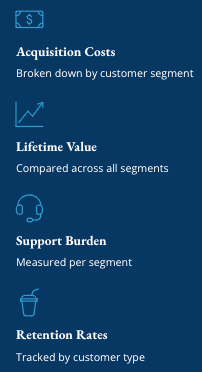
We analyzed their customer data the way we'd analyze product profitability:
- Acquisition costs by segment
- Lifetime value by segment
- Support burden by segment
- Retention rates by segment
What we found changed everything: Almost all their profit came from one specific customer segment. The rest were either breaking even or losing money.
Once they saw this, they made a dramatic shift:
- Rebuilt marketing around that one ideal customer profile
- Redesigned their product to serve that segment better
- Stopped chasing customers who would never be profitable
The result? They eventually sold the business for over $30 million. Not because they grew revenue everywhere. Because they focused on the customers who actually made them money.
Why Do Most Founders Underprice?
Profitability isn't just about costs. It's about what you charge.
Most founders underprice. They look at competitors and worry about losing deals, so they set prices based on fear instead of value.
If you're not losing some deals on price, you're probably not charging enough.
A Pricing Turnaround Example
One service business we work with was stuck at the same revenue level for three years. They were busy, but they couldn't seem to grow. When we analyzed their situation, the answer was simple: their pricing hadn't changed in five years while their costs and capabilities had grown substantially.
They were afraid to raise prices. They thought they'd lose clients. But when they finally adjusted their rates to reflect the value they actually delivered, something unexpected happened:
- They lost a few clients (the ones who didn't value the work anyway)
- The clients who stayed were happy to pay more
- New clients came in expecting to pay the higher rates
Their profit nearly doubled within a year. Same team. Same services. Different price.
How Do You Know If Your Business Has a Profit Visibility Problem?
Before you can optimize profit, you need visibility. Ready Founders can answer these questions:
- Which customers or customer segments generate the most profit? The least?
- Which products or services have the highest margins? The lowest?
- What does it actually cost to serve each type of customer?
- Are your prices aligned with the value you deliver?
- If you had to cut 20% of your customer base, which ones would you let go?
If you can't answer these questions with confidence, you're optimizing blind.
How to Start Analyzing Profit by Segment
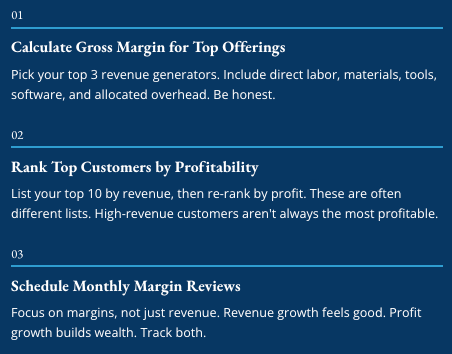
You don't need to rebuild your entire financial infrastructure overnight. Start with these three steps:
Step 1: Calculate Gross Margin for Your Top Offerings
Pick the three offerings that generate the most revenue and figure out what they actually cost to deliver. Include:
- Direct labor costs
- Materials and supplies
- Tools and software
- Allocated overhead
Be honest about the numbers.
Step 2: Rank Your Top Customers by Profitability
List your top ten customers by revenue, then rank them by profitability. These are often different lists.
The customer who pays you the most isn't always the customer who makes you the most money. Some high-revenue customers come with high costs: demanding service requirements, custom work, scope creep, payment delays. Others are profitable precisely because they're low-maintenance.
Step 3: Schedule Monthly Margin Reviews
Schedule a monthly P&L review focused on margins, not just revenue. Revenue growth feels good. Profit growth builds wealth. Make sure you're tracking both.
When Should You Prioritize Profit vs. Growth?
Optimizing profit isn't always about cutting costs or raising prices today.
Sometimes the right move is investing in growth that will generate profits later. The question is whether you're making that trade-off intentionally or accidentally.
When to prioritize growth:
- Early-stage businesses building market share
- Expanding into new markets with proven unit economics
- Investing in systems that will reduce costs at scale
When to prioritize profit optimization:
- Mature businesses with established market position
- Preparing for exit or acquisition
- Cash flow constraints limiting growth investment
Ready Founders know when they're investing for growth versus optimizing for profit. They make that choice deliberately, based on data, not based on whatever feels right in the moment.
The worst position is not knowing which mode you're in.
What Changes When You Have Profit Visibility?
When you have true profit visibility, your decisions get easier and your business gets stronger.
- You know which customers to invest in and which ones to gracefully transition out
- You know which products to double down on and which ones to sunset
- You know whether your growth is actually building value or just building overhead
You stop chasing revenue for revenue's sake. You start building a business that's worth something.
That's what separates founders who work hard from founders who build wealth.
Your Challenge This Month
Pick one segment of your business, whether that's a customer type, a product line, or a service offering, and calculate its true contribution margin.
Include everything: the direct costs, the overhead allocation, the hidden expenses that don't show up on a simple P&L. Be ruthlessly honest.
Then ask yourself:
- If this segment is profitable, how do I get more customers like this?
- If it's not, what would need to change?
That single analysis will teach you more about your business than months of revenue reports.
Frequently Asked Questions
1. What is profit by product?
Profit by product (or profit by segment) is a financial analysis that breaks down profitability at the individual product, service, or customer level rather than looking only at overall company profit. This reveals which parts of your business are actually generating profit and which are losing money.
2. How do you calculate contribution margin?
Contribution margin equals revenue minus all variable costs associated with that product, service, or customer segment. Variable costs include direct labor, materials, sales commissions, and any other costs that scale with that specific offering. The formula is: Contribution Margin = Revenue - Variable Costs.
3. Why do service businesses need to analyze profit by "product"?
Service businesses have segments that behave like products when analyzed for profitability. These might include different client types (retainer vs. project), different service offerings (strategy vs. implementation), or different customer sizes (enterprise vs. small business). Each segment has different costs to serve and different margins.
4. How often should founders review profitability by segment?
Most growth-stage founders benefit from monthly margin reviews at minimum. Quarterly detailed reviews of segment-level profitability help identify trends and inform strategic decisions about pricing, resource allocation, and customer focus.
Want the visual summary? Download the PDF version here.
The Ready Founder™ is part of One Degree Financial's commitment to helping founders gain the financial clarity and confidence they need to scale and exit successfully.
Ready to see what your numbers are really telling you? Book a conversation to discuss building profit visibility in your business: Schedule a conversation.
Want our monthly newsletter delivered to your inbox, sign up here.
About the Author: Rod Loges is CEO of One Degree Financial and host of the MILCOM Founders podcast, where he helps veteran entrepreneurs build businesses with strong financial foundations.