


Most founders think tax planning means filing on time. It doesn’t.
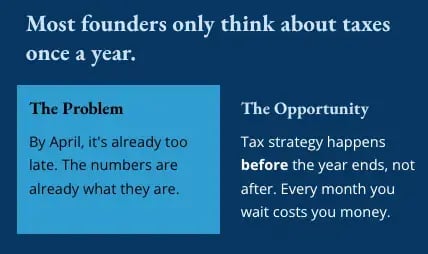
Most founders only think about taxes in April. Here are nine tax strategies for growth-stage founders, from entity selection to the R&D credit, that could save you thousands.

Tax season is over. You filed. You wrote the check. And if you’re like most founders we work with, you’re already trying to forget the whole thing happened.
We get it. But this is actually the best time of year to do something about it. The numbers are fresh. You remember what hurt. You probably have a pretty good sense of what could have gone differently.
So instead of general advice about planning year-round, here are nine specific tax strategies that most founders in the $500K to $5M range don’t know about. Some might apply to you. Some won’t. But you should know they exist, because any one of them could be worth thousands of dollars the next time you file.
Nine Tax Strategies for Founders
1. Employer Benefit Package Review
Most founders set up their compensation early and never revisit it. A full benefits review looks at how your entire compensation and benefits structure affects your tax position: pre-tax retirement contributions through the right vehicle, an accountable plan for tax-free expense reimbursement, health coverage structured for the best deduction, and benefits that attract key team members while reducing taxable income. When a CFO runs this analysis, savings almost always turn up.
2. Choice of Entity
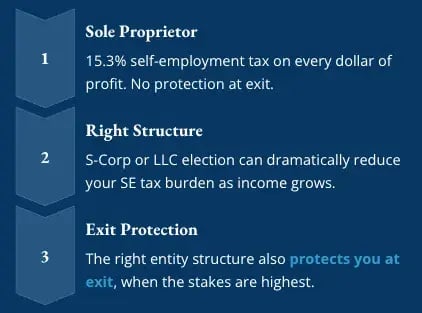
The difference between running as an LLC taxed as an S-Corp versus a sole proprietor can mean tens of thousands of dollars in self-employment taxes. Once you cross roughly $100K in net income without an S-Corp election, you’re likely overpaying. Entity structure also pays off at exit: C-Corp founders who hold qualified small business stock for five or more years may exclude up to $10 million in gains from federal tax under Section 1202 (QSBS).
3. Home Office Deduction
If you use a dedicated space in your home regularly and exclusively for business, you can deduct a portion of your rent or mortgage, utilities, insurance, and maintenance. The IRS offers a simplified method ($5 per square foot, up to 300 square feet) or actual-expense calculation. For founders who work from home, this can add up to several thousand dollars a year in unclaimed deductions.
4. Solo 401(k)
If you have no full-time employees other than yourself (and possibly your spouse), a Solo 401(k) lets you contribute far more than a traditional plan. For 2026, that’s up to $24,500 as an employee contribution, plus up to 25% of net self-employment income as an employer contribution, for a combined maximum of $72,000. Every dollar reduces your taxable income for the year.
5. Augusta Rule
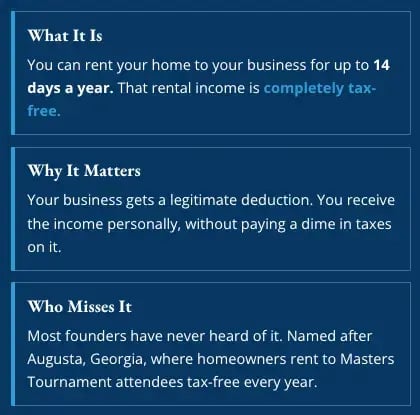
Under Section 280A, you can rent your personal home to your business for up to 14 days per year, and that rental income is completely tax-free. Your business deducts the rental payment as an expense, and you receive the income without paying taxes on it. The rate has to be reasonable and the use has to be for legitimate business purposes like team meetings or client events. We covered this in detail in our tax planning video.
6. Wages: Hiring Your Kids
If you have children under 18 and operate as a sole proprietorship or single-member LLC, you can pay them a reasonable wage for legitimate work. That income isn’t subject to Social Security or Medicare taxes, and depending on the amount, may not be subject to income tax. Your business gets the deduction, and the money stays in the family.
7. R&D Tax Credit
If your business develops new products, software, processes, or formulas, you may qualify for the Research and Development tax credit. It can offset income taxes, and for qualifying small businesses, it can be applied directly against payroll taxes, making it valuable even before profitability. This is one of the most underused credits available to founders in tech and defense.
8. Depreciation and Expensing
Section 179 lets you deduct the full purchase price of qualifying equipment in the year you buy it, and bonus depreciation can extend that further. The timing matters: buying equipment in December versus January can shift a significant deduction into the current tax year. A good CFO factors this into purchasing decisions instead of recording them after the fact.
9. Income and Deduction Timing
If you have any control over when income hits your books or when you pay deductible expenses, you can shift taxable income between years to manage your overall rate. The goal is to avoid spikes that push you into higher brackets when a more level approach would cost less. This takes planning and good financial data, which is why quarterly check-ins matter.
The Bigger Picture
None of these strategies work in isolation. The right combination depends on your entity type, revenue, growth stage, and personal financial goals. What works for a solo founder doing $600K looks very different from what works for a team of ten doing $4M. The real value isn’t in knowing these strategies exist. It’s in having someone who can look at your full financial picture and tell you which apply to your situation right now.
Ready Founders™ treat tax planning as a year-round discipline. They schedule quarterly conversations with their financial team, adjust when the business changes, and build their tax liability into their cash flow forecast so a big bill never catches them off guard.
Frequently Asked Questions
1. When is the best time to start tax planning?
The best time is now, not at filing. Tax planning works when it happens throughout the year, ideally with quarterly reviews tied to your actual business performance. Waiting until April means you’re reporting what already happened instead of shaping the outcome.
2. Do I need a CFO to use these strategies?
Not necessarily, but you do need someone who understands your full financial picture and can tell you which strategies apply to your situation. A financial leadership advisor can do this without the cost of a full-time hire, which is why many growth-stage founders work with an outside financial leader rather than handling it alone or relying only on a once-a-year CPA relationship.
3. What’s the difference between a CPA and a CFO for tax planning?
A CPA typically prepares and files your taxes, often reactively after the year ends. A CFO (or CFO advisor) works proactively throughout the year, building tax strategy into your broader financial plan, cash flow, and growth decisions. The two roles complement each other.
4. Are these tax strategies only for large companies?
No. Most of these are specifically valuable for growth-stage founders in the $500K to $5M range. Strategies like the R&D credit, the Augusta Rule, and entity selection are often more impactful for smaller, growing businesses than for large corporations.
5. How much can tax planning actually save a founder?
It varies widely based on your revenue, entity structure, and which strategies apply. Even modest planning can save five figures a year. The point isn’t a single number; it’s that proactive planning consistently keeps more money in your business than reacting at filing time.
Want the visual summary? Download the PDF version here.
The Ready Founder™ is part of One Degree Financial's commitment to helping founders gain the financial clarity and confidence they need to scale and exit successfully.
Ready to see where your business stands? Take the Ready Founder™ Assessment to find out where your financial leadership is strong and where the gaps are. Ready to build a growth strategy based on real numbers? Book a financial readiness call with our team.
This is the overview. The subscriber version includes Rod's firsthand experience with a costly tax mistake at exit, deeper detail on each strategy, and how Ready Founder™ discipline turns tax planning into a year-round advantage. Subscribe to The Ready Founder™ newsletter for the full breakdown, delivered monthly. Sign up here.
About the Author: Rod Loges is CEO of One Degree Financial and host of the MILCOM Founders podcast, where he helps veteran entrepreneurs build businesses with strong financial foundations.