


This is the second of two newsletters on Revenue Growth Strategy, one of the eight pillars of the Ready Founder framework. Last month we covered how to calculate your real Customer Acquisition Cost. This month, we're covering the growth discipline that most founders struggle with the most: walking away from revenue that doesn't fit.
Most Founders Learn How to Sell. Fewer Learn When to Walk Away.

Why the Best Growth Decision Is Sometimes Walking Away
Not all revenue is good revenue. Some opportunities that look great on paper carry risk profiles, contract terms, or operational demands that can damage your business more than they grow it. The founders who scale well are the ones who know how to evaluate whether an opportunity actually fits their business, and who have the discipline to walk away when it doesn't. This article covers how to evaluate revenue opportunities, what concentration risk is, why growth without systems breaks, and what one founder learned by turning down a major deal.
Most Founders Learn How to Sell. Fewer Learn When to Walk Away.
What Happens When a Founder Says No to a Major Deal?
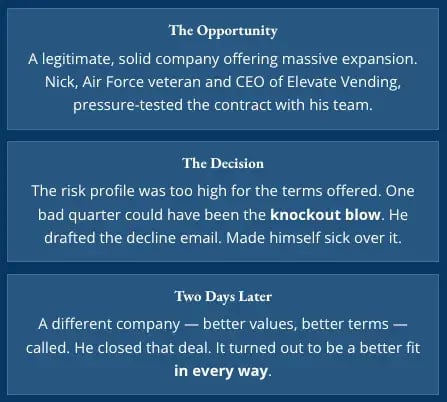
A founder I work with got the call every small business owner dreams about. A major publicly traded company wanted to expand their partnership from four locations to more than fifty nationwide. The pilot had been a success. The numbers were real. The growth potential was enormous.
He turned it down.
The opportunity was legitimate and the company was solid. None of that was the issue. The issue was that when he and his team ran the numbers and pressure-tested the contract, the risk profile was too high for the terms they were being offered. The growth would have stretched his business to a point where one bad quarter could have been the knockout blow.
So he picked up the phone, talked to his partners, his mentors, and his advisors. Then he drafted an email declining the expansion. He made himself sick over it. His words, not mine. He couldn't believe he'd just said no to what felt like a Shark Tank moment.
Two days later, he got another call. A different company, one whose values and terms aligned closely with his business, wanted to expand their partnership significantly. He closed that deal. It turned out to be a better fit in every way.
That founder is Nick Grillo, an Air Force veteran and CEO of Elevate Vending. Nick shared this story when he joined Rod Loges, CEO of One Degree Financial, on the MilCom Founders Podcast. Nick and his team brought this decision to One Degree to help them work through it. What stood out was that Nick already understood something that takes most founders years to learn: not all revenue is good revenue.
Why Is Saying No to Revenue So Hard for Founders?
Early in my career, I said yes to everything. Every opportunity, every customer, every ask that came through the door. I thought that's what growth required.
What it actually required was discipline. Knowing what to say no to so I could say yes to what mattered.
What it actually required was discipline. Knowing what to say no to so I could say yes to what mattered.
When you're in growth mode, saying no feels wrong. You've spent months or years trying to get revenue in the door. You've made the calls, sent the follow-ups, lost sleep over pipeline. And now someone is handing you exactly what you asked for, and the right answer might be to walk away?
Sometimes it is.
The founders I respect most are ruthless about focus. They know their lane and they protect it. They turn down revenue that doesn't fit. That discipline compounds over time in ways that chasing every dollar never will.
How Do You Know When Revenue Doesn't Fit Your Business?
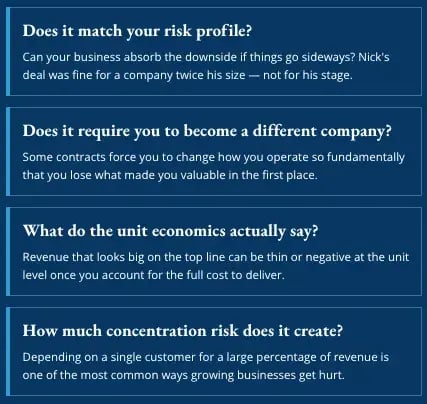
Not every opportunity that looks good on paper is good for your business. Here are four questions worth running before you sign:
1. Does it match your risk profile?
Nick's publicly traded opportunity would have been fine for a company twice his size with deeper reserves. For his business at that stage, it was a knockout punch waiting to happen. What matters is whether your business can absorb the downside if things go sideways.
2. Does it require you to become a different company?
Some contracts force you to change how you operate so fundamentally that you lose what made you valuable in the first place. Nick's team offers a concierge-style service with premium equipment and locally sourced products. The contract terms didn't leave room for that. Accepting would have meant becoming a different business to serve a customer who didn't value what made them special.
3. What do the unit economics actually say?
Revenue that looks big on the top line can be thin or negative at the unit level once you account for the full cost to deliver. If you don't know your unit economics by customer or segment, go back to last month's newsletter and do that work first. You can't evaluate an opportunity you can't measure.
4. How much concentration risk does it create?
Concentration risk is what happens when a large percentage of your revenue depends on a single customer, contract, or channel. If that customer leaves or changes terms, you don't just lose revenue. You lose the infrastructure, team, and capacity you built around them. For growing businesses, concentration risk is one of the most common paths to a cash flow crisis.
When Does Revenue Growth Actually Hurt Your Business?
If your business is growing but you're working more hours, feeling more stressed, and losing control, something's wrong.
I've worked with founders who doubled their revenue and ended up with cash flow challenges and less profitability overall. They were making more money on paper, but their hours had ballooned, their stress was through the roof, and their margins had thinned out. I've made that mistake myself. Revenue was growing and freedom was shrinking. That's just a nicer-looking version of being stuck.
Revenue was growing and freedom was shrinking. That's just a nicer-looking version of being stuck.
On the MilCom Founders Podcast, Nick put it simply: "Don't let your business run you. You run your business." That sounds simple. It is not. Running your business means making hard calls when the easy answer is to say yes and figure it out later.
The founders who scale well aren't the ones chasing every yes. They've done enough work on their numbers, their risk tolerance, and their strategy to know when no is the better answer.
Why Do Your Systems Determine Your Growth Ceiling?
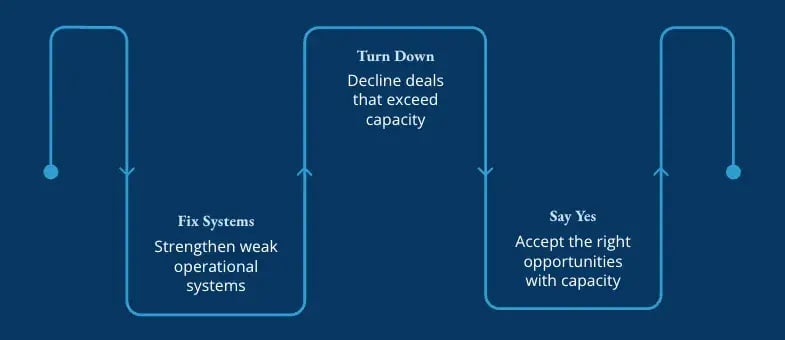
Your business will scale to the limit of your weakest system and then stop. If your onboarding process breaks at ten customers, you can't successfully serve twenty. If your sales process requires you in every meeting, you can't scale past your personal capacity.
Your business will scale to the limit of your weakest system and then stop.
Growth reveals which systems work and which ones don't. The time to fix them is before you need them, not in the middle of a crisis you could have seen coming.
When Nick turned down the large contract, part of his calculation was that his systems weren't ready for that kind of scale on those terms. He could have said yes and hoped things worked out. Instead, he made the harder call. When Monumental Sports called two days later, he had the capacity to say yes because he hadn't stretched himself thin on the wrong deal.
How Should Founders Make High-Stakes Revenue Decisions?
Nick didn't make that decision alone. He leaned on his business partners, his mentors through the PenFed Foundation's VEP program, and his advisory relationships. He gathered perspectives from people who didn't have the same emotional investment in the opportunity that he did.
Most founders who take the wrong deal don't do it because they can't run the numbers. They do it because they're standing in front of a life-changing opportunity and the excitement is louder than the math. Having people around you who can look at the numbers without the adrenaline is one of the most valuable things you can build as a founder.
The excitement is louder than the math.
Your Challenge This Month
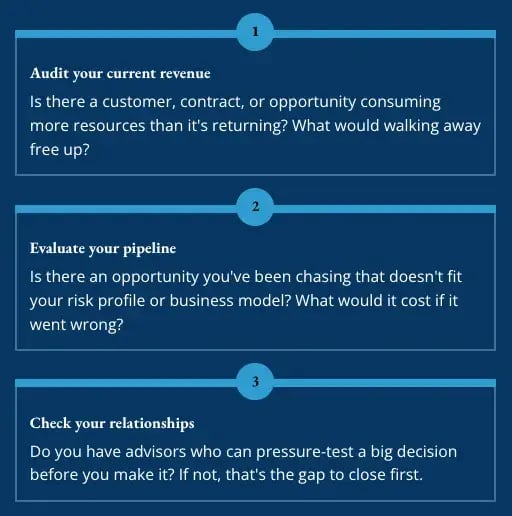
Look at your current revenue and your pipeline. Ask yourself:
- Audit your current revenue. Is there a customer, contract, or opportunity that's consuming more resources than it's returning? What would it take to walk away from it, and what would that free up?
- Evaluate your pipeline. Is there an opportunity you've been chasing that doesn't fit your risk profile or your business model? What would it cost you if it went wrong?
- Check your relationships. Do you have the relationships in place to pressure-test a big decision before you make it? If not, that's the gap to close first.
Saying no to revenue is a discipline. It gets easier with practice, and the founders who build that muscle tend to find that the right opportunities show up once they stop filling their calendar with the wrong ones.
Stop guessing. Start leading.
Frequently Asked Questions
1. What does "not all revenue is good revenue" mean?
It means that some customers, contracts, or opportunities cost more to serve than they return in profit, strategic value, or long-term growth. Revenue that strains your operations, increases your risk beyond what your business can absorb, or forces you to change your business model in ways that hurt your core offering can do more damage than good, even when the top-line number looks impressive.
2. How should a founder evaluate whether to accept or decline a business opportunity?
Start by testing the opportunity against your risk profile, your unit economics, and your current operational capacity. Ask whether the contract requires you to fundamentally change how you operate, whether the terms create dangerous concentration risk, and whether the revenue is actually profitable at the unit level once you account for the full cost to deliver. Get outside perspectives from advisors or mentors who are not emotionally invested in the deal.
3. What is concentration risk and why is it dangerous for growing businesses?
Concentration risk occurs when a large percentage of your revenue depends on a single customer, contract, or channel. If that customer leaves, changes terms, or reduces their spend, you lose not only the revenue but also the team, infrastructure, and capacity you built to serve them. For growing businesses, concentration risk is one of the most common paths to a cash flow crisis.
4. When should a founder walk away from a potential customer or contract?
Walk away when the deal requires you to become a different company to serve it, when the risk profile exceeds what your business can absorb if things go wrong, when the unit economics are thin or negative after full cost accounting, or when it creates dangerous concentration risk. The discipline of saying no protects your capacity to say yes to the right opportunity when it arrives.
Want the visual summary? Download the PDF version here.
The Ready Founder™ is part of One Degree Financial's commitment to helping founders gain the financial clarity and confidence they need to scale and exit successfully.
Ready to see where your business stands? Take the Ready Founder™ Assessment to find out where your financial leadership is strong and where the gaps are. Ready to build a growth strategy grounded in your real numbers? Book a strategy session with our team.
Hear Nick Grillo’s full story on the MilCom Founders Podcast: Episode 12
Want our monthly newsletter delivered to your inbox? Sign up here: readyfounder.substack.com
About the Author: Rod Loges is CEO of One Degree Financial and host of the MilCom Founders podcast, where he helps veteran entrepreneurs build businesses with strong financial foundations.
One Degree Financial | Financial Leadership for Founders
onedegreefinancial.com
Lead · Adapt · Thrive