


Why your CPA and your bookkeeper never brought this up

A founder I work with built a $4 million business. Clean books, good CPA. He was paying three different financial professionals, and every one of them was doing their job well.
Then I asked him a simple question: If you got hit by a bus tomorrow, who runs the company? Who walks in Monday morning, signs the checks, and keeps the lights on?
He didn't have an answer.
No will. No trust. No one in his life with the legal authority to access business accounts or make decisions about the company he'd spent a decade building.
His CPA files his taxes. His bookkeeper categorizes transactions. Neither of them was ever going to ask him what happens to his business when he dies. That's not their job. But somebody should have asked. And nobody did.
What happens to a business when the founder dies without a plan?
Without a trust or estate plan, the business goes into probate, and no one can make decisions, sign checks, or access accounts until a court grants permission. That process can take months.
We talk a lot in this newsletter about beginning with the end in mind. What's your endgame? When do you want to exit, and on what terms? Those questions assume you'll be around to execute the plan.
Sometimes you won't be. A health crisis that shows up without warning. An accident that changes everything in an afternoon.
I worked with a founder who built a $10 million business. Revenue growing, team performing, real momentum. But he had almost nothing saved personally. Every dollar went back into the company. Then he got sick. A health crisis that forced him to step back. Without him running operations, the business couldn't sustain itself. He needed liquidity, but there was none outside the company. He had to sell fast, and the deal he got was a fraction of what the business could have been worth with proper preparation and timing.
That's the version where you're still alive to make decisions. The version where you're not is worse.
That's the one nobody on your advisory team has planned for.
Why doesn't your CPA or bookkeeper bring up estate planning?
Estate planning falls outside the scope of every financial professional most founders pay. Your CPA handles tax and compliance. Your bookkeeper handles transactions. A fractional CFO handles forecasting. None of them are responsible for what happens when you're not there, so none of them raise it.
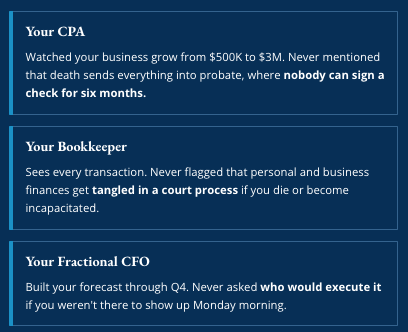
Your CPA watched your business grow from $500K to $3 million and never once said, "By the way, if something happens to you, this whole company goes into probate and nobody can sign a check for six months." Estate planning isn't on his checklist. CPAs optimize for tax and compliance. That's what you pay them for.
Your bookkeeper has been inside your financials for years. She sees every transaction in every account. She never flagged that your personal and business finances would get tangled up in a court process if you died, or that nobody else can access those accounts in an emergency.
And if you have a fractional CFO giving you a monthly deck, he built your forecast through Q4 but never asked who would execute it if you weren't there. He models your cap table and your valuation but has never raised the question of what triggers a forced transition.
Estate planning falls between every chair in the room, so it hits the floor.
The people managing your money aren't thinking about what happens to it when you can't.
If you have a business partner, the consequences get worse. Sean Joyner, an estate planning attorney we talked with for this article, put it bluntly: you could end up in a partnership with your ex-partner's three-year-old daughter, because their interest passes to their minor child. And if your personal and business finances aren't cleanly separated (something we covered in our July newsletter), the exposure compounds fast.
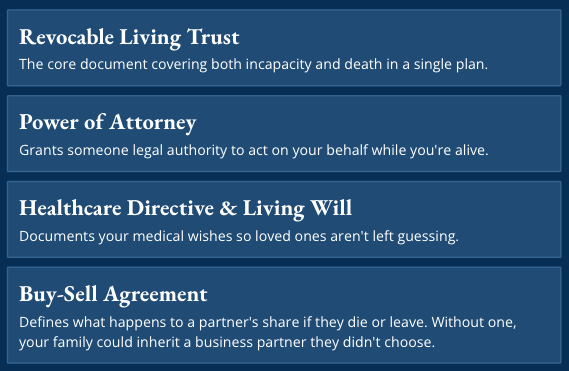
A power of attorney dies with you. The moment you pass, a POA has no legal force. So if your only planning document is a POA, your family still has no authority the day after you're gone. A trust is the document that covers both incapacity and death in a single plan.
None of this is hypothetical. I've watched it happen.
What estate planning documents does a business owner need?
Four documents protect your business and family if you can't show up tomorrow. If your financial team were paying attention to more than their own lane, they would have flagged these by now.
- Revocable living trust. Keeps your business out of probate entirely. Someone you've chosen can step in and operate or wind down the business without waiting months for a court to grant permission. Your CPA knows your entity structure inside and out. He could have connected you to an estate attorney two years ago.
- Durable power of attorney. Gives someone the legal authority to act on your behalf if you're incapacitated but still alive. Without it, your family may need to go to court just to access business bank accounts. Most founders don't think about this until they're in a hospital bed and their spouse can't get into the operating account.
- Buy-sell agreement funded by insurance. If you have partners, this makes the transition clean and fair. Your partner doesn't end up in business with your spouse, and your spouse isn't stuck holding an illiquid asset with no way to sell. The question of what triggers a forced transition is one your advisors should have raised years ago.
- Key person documentation. Tells your team and your family who does what, where the critical information lives, and what decisions need to be made first. It's the operating manual for the business that only matters when you're not there to explain it yourself.
The cost of setting these up is small compared to what your family stands to lose without them. The problem is that nobody in your current setup sees it as their responsibility.
Why Three Founders Asked Us to Be Their Trustee
I'll be honest. When the first founder asked me to be named as the trustee of his estate, it hit me in a way I wasn't expecting. That's a level of trust that goes well beyond a financial advisory relationship. It means someone looked at the full picture of their life and their business and said, "If something happens to me, I want you to be the one making sure this gets handled right."
Three founders have asked us to serve in that role. Each time, the process of getting the estate plan in place provided something I didn't fully appreciate until I saw it happen: comfort, relief, direction. Peace of mind that the people they care about, and the business they built, would be taken care of.
One of those founders passed away, and his son recently told me that the best thing he inherited from his dad was having us in place as trustee. We helped him and the business survive his father's passing. The business is thriving again. That was possible because his dad had the foresight to get everything set up before he got sick.
I've also seen the other side. One of my closest friends, Dmitry, had his entire estate plan drafted and ready to sign. Every week we talked, and every week I asked him, "Why haven't you signed it?" He kept thinking he had more time. Then he went into a coma and never signed. He left behind a mess that took months to sort through. He probably would have laughed about it, but the people he cared about paid the price.
He kept thinking he had more time. Then he went into a coma and never signed.
Forget the legal checklist for a second. That's what this is really about. It's knowing that if life throws the worst at you, the people who depend on you aren't left figuring it out alone.
How much does an estate plan cost for a business owner?
A revocable living trust with all supporting documents costs about $5,000. Funding the trust (having the attorney retitle assets so it actually works) runs roughly another $2,000. The full process takes about two to three months.
We talked with Sean Joyner, an estate planning attorney at Joyner Trust Law, about what founders specifically need to know.
Sean's first question for any founder is one most of them haven't considered: what are your goals? As he told us, "If you really don't care about what's going to happen after you're gone, then save your money. But if you actually care about what's going to happen to your business partners, your minor children, or your spouse, then you really need to be thinking about what your goals are."
Here's what a typical estate plan for a business owner includes and what it costs:
- Revocable living trust with power of attorney, healthcare directive, and living will: approximately $5,000
- Trust funding (retitling assets into the trust): approximately $2,000
- Timeline: two to three months from first call to completed, funded plan
One warning from Sean worth repeating: "If you have a trust and you don't fund it properly, you've just bought an expensive pile of paper." The plan has to be funded. Assets have to be retitled into the trust. Otherwise, you're back in probate, which is exactly what you were trying to avoid.
"If you have a trust and you don't fund it properly, you've just bought an expensive pile of paper."
Sean's firm is based in Reston, Virginia. You can book a 15-minute intro call at joynertrustlaw.com. If you're outside Virginia, look for an estate planning attorney who specializes in working with business owners, not just individuals.
Your Challenge This Month
Answer one question: If you couldn't show up to work tomorrow, permanently, does anyone in your life have the legal authority and documented guidance to keep your business running and protect your family's interest in it?
If the answer is no, this is the month to fix it. The founders who've done it told me the same thing: the relief alone was worth it. And by the time you need it, it's too late to put it together.
Frequently Asked Questions
What happens to my business if I die without an estate plan?
Your business goes into probate. No one can sign checks, access business bank accounts, or make operational decisions until a court grants authority, which can take months. During that time, your family is making business decisions under enormous emotional stress with no documented guidance from you. If your personal and business finances aren't cleanly separated, the exposure compounds.
Do I need a trust if I already have a CPA and bookkeeper?
Yes. Your CPA optimizes for tax and compliance. Your bookkeeper categorizes transactions. Neither of them is responsible for what happens to your business or your family's access to it if you die or become incapacitated. A revocable living trust fills the gap that no one on your current financial team covers, keeping your business out of probate and giving someone you've chosen the authority to act immediately.
What's the difference between a power of attorney and a trust for business owners?
A power of attorney gives someone authority to act on your behalf while you're alive but incapacitated. It dies with you. The moment you pass, a POA has no legal force, and your family has no authority over business accounts or decisions. A revocable living trust covers both incapacity and death in a single plan, allowing someone you've chosen to step in and operate or wind down the business without court involvement.
How much does a revocable living trust cost for a business owner?
A revocable living trust with all supporting documents (power of attorney, healthcare directive, living will) typically costs about $5,000. If you want the attorney to handle trust funding (retitling assets into the trust so it actually works), that's roughly another $2,000. Timeline is about two to three months from your first call to a completed, funded plan.
What is a buy-sell agreement and why do founders with partners need one?
A buy-sell agreement, typically funded by insurance, sets the terms for what happens to a partner's ownership share if they die, become disabled, or leave the business. Without one, your partner's share passes to their heirs. That could mean you're suddenly in a partnership with your late partner's spouse or minor children, and they're stuck holding an illiquid asset they can't sell. A buy-sell agreement makes the transition clean and fair for everyone.
Stop guessing. Start leading.
The Ready Founder™ is part of One Degree Financial's commitment to helping founders gain the financial clarity and confidence they need to scale and exit successfully.
Ready to see where your business stands? 16 questions. You'll know where your weak spots are and what to work on first. Take the Ready Founder Self-Assessment.
Want the full newsletter with additional detail each month? Sign up here.
About the Author: Rod Loges is CEO of One Degree Financial and host of the MilCom Founders podcast, where he helps veteran entrepreneurs build businesses with strong financial foundations.
One Degree Financial | Financial Leadership for Founders
onedegreefinancial.com
Lead · Adapt · Thrive