


Why your 2027 goals are only as good as the numbers behind them

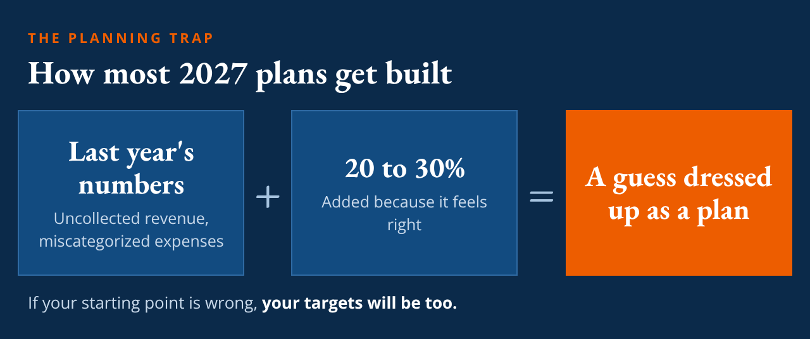
Every fall, I watch founders do the same thing. They pull up last year's numbers, add 20 or 30 percent, and call it a plan.
The problem is, those numbers are often wrong.
When I ask a founder how much cash they have on hand, the answer is almost never a number. It's "I think" or "I'd have to check." One founder told me she'd have to apologize for what I was about to see before she'd open her books. Another hit his revenue targets and still couldn't tell me what his actual expenses were.
Why are my 2027 goals based on the wrong numbers?
Because your books and your business often tell different stories. There may be revenue in your books that was never collected, or expenses that got miscategorized months ago and nobody caught.
I talk to founders pulling in over a million dollars in revenue who still can't tell me their actual monthly burn rate. Their CPA files the taxes on time. Their bookkeeper records the transactions. Nobody is connecting those pieces into a financial picture the founder can actually use.
Growth makes the gap harder to see. I've sat across from founders who doubled their revenue in a year and still couldn't tell me what it cost to acquire a customer or whether their margins had held. They planned from the confidence that growth gave them instead of from the numbers.
If your starting point is wrong, your targets will be too.
What should a founder measure before setting annual goals?
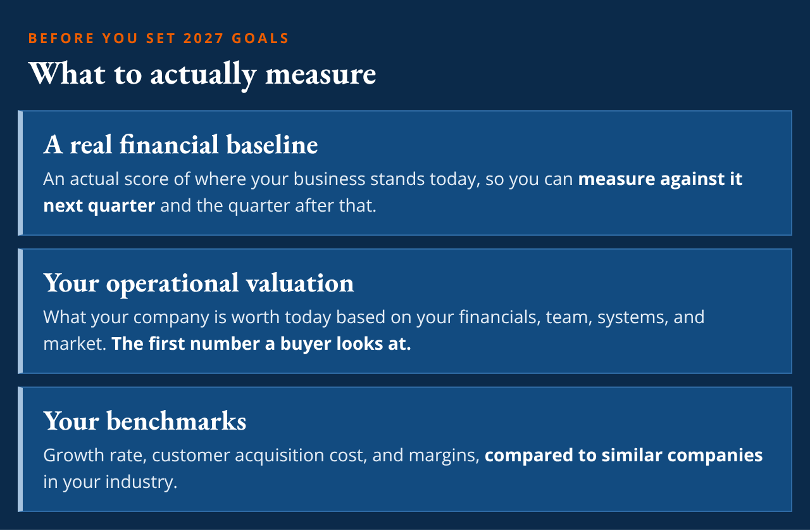
Before you write a single goal, get a real financial baseline, know your operational valuation, and benchmark your performance against similar companies.
A real financial baseline. An actual score that tells you where your business stands right now, so you have something to measure against next quarter.
Your operational valuation. What your company is actually worth today. If you're building toward an exit or acquisition, this is the first number a buyer will look at, and most founders have never calculated it.
Your benchmarks. Your growth rate, your cost to acquire a customer, and your margins, compared to similar companies in your industry. You can't evaluate your own performance in a vacuum.
How do you know if a revenue goal is realistic?
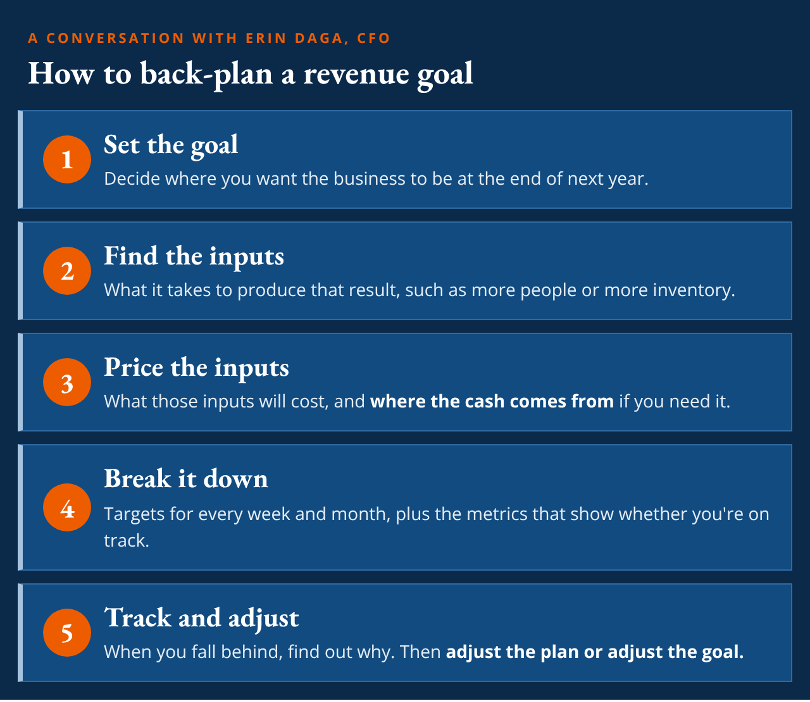
Work backward from it. Figure out what it takes to get there and what that costs, then set monthly targets that show whether you're on track.
Erin Daga, ODF's Chief Financial Officer, does this with founders every year. She described one client's goal this way.
"We have a client this year who set a goal of $10 million in revenue. Great goal. But he did not know how to get there. That is where your CFO and accounting team becomes really helpful. We look at industry-standard growth rates. We look at what inputs are required to hit those targets and how much money those inputs will cost. Then we can say: to reach this goal, here is what you need to do each week, each month, each quarter. And here are the metrics that will show whether you are on track."
When the numbers fall behind, Erin's team looks at why. Maybe the goal was too aggressive, or a cost came in higher than expected. Then they adjust the plan or adjust the goal.
What costs should founders plan for in 2027?
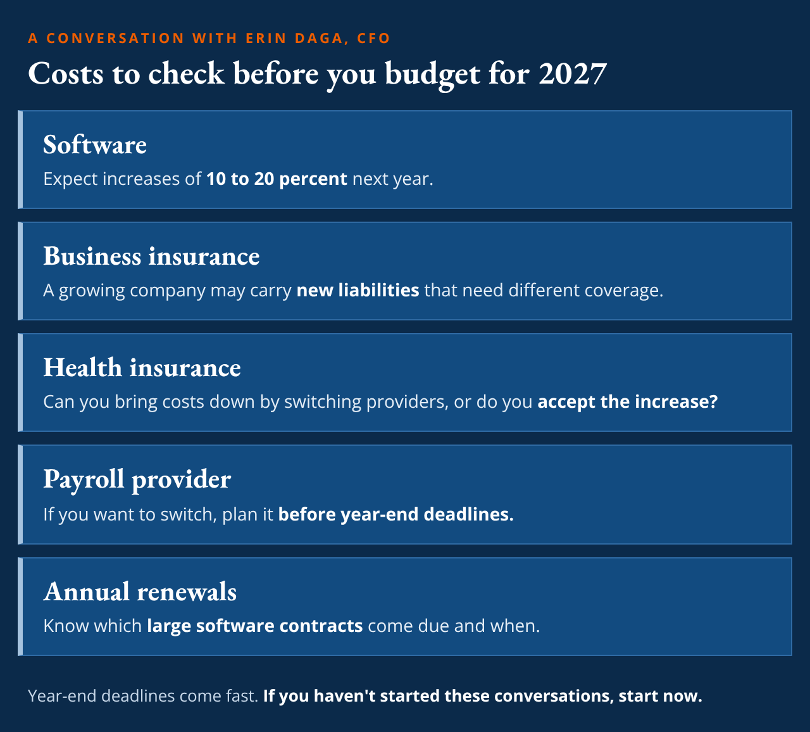
Plan for most of your costs to go up. Erin expects software expenses alone to rise 10 to 20 percent next year.
"It is not enough to look at last year and assume the same thing will happen again."
She also looks at whether a growing company needs different insurance for new liabilities, whether switching health insurance providers could bring costs down, and which large annual software renewals are coming due. If you want to switch payroll providers or insurance plans, year-end deadlines arrive fast.
Do you trust the financial picture you're looking at?
The founders I've seen come out ahead when opportunity shows up are the ones who started with honest numbers. They set accurate goals, and that started with getting a clear financial picture before they planned anything.
Your numbers should inform your decisions. If they can't do that right now, that's the first thing to fix before January.
So ask yourself this month: do I trust the financial picture I'm looking at? If the answer is anything less than yes, you know where to start.
Take the Financial Clarity Self-Assessment. 16 questions. You’ll know where your weak spots are and what to work on first. → https://bit.ly/47HdQ2u
Ready to talk it through? Book a financial clarity call with our team.
Want the full conversation with Erin, including how she tracks operational valuation month to month? Get the Ready Founder™ newsletter.
Frequently Asked Questions
What is a financial baseline for a small business?
A financial baseline is a clear, measured picture of where your business stands today. It gives you a starting point to track against each quarter, so your goals are built on real numbers instead of estimates.
How is operational valuation calculated?
It depends on the industry. As Erin Daga, CFO at One Degree Financial, puts it, "It might be a multiple of your annual revenue. It might be a multiple of your EBITDA." ODF researches what's standard for a client's industry and tracks valuation monthly to show whether it's moving toward the target.
How much will software costs go up in 2027?
Erin Daga, CFO at One Degree Financial, expects most businesses to see software expenses rise 10 to 20 percent next year. Review your annual renewals before you set your budget.
When should a business start planning for next year?
Earlier than most founders think. Erin starts these conversations with clients in August, which leaves time to switch payroll or insurance providers and review large software renewals before year-end deadlines.
Why doesn't my CPA or bookkeeper give me a full financial picture?
Your CPA files your taxes and your bookkeeper records your transactions. Neither role is set up to connect those pieces into a picture you can plan from. That's the work a CFO does.
Stop guessing. Start leading.
The Ready Founder™ is part of One Degree Financial's commitment to helping founders gain the financial clarity and confidence they need to scale and exit successfully.
About the Author: Rod Loges is CEO of One Degree Financial and host of the MilCom Founders podcast, where he helps veteran entrepreneurs build businesses with strong financial foundations.
One Degree Financial | Financial Leadership for Founders
onedegreefinancial.com
Lead · Adapt · Thrive